Showing posts with label Kansas City. Show all posts

Thursday, May 15, 2008

Reunited


Sometimes it's the little things.

We just spent six months camping out in a rented place in Oak Park. It was less than half the size of our place in Kansas City but had a full basement. The idea was to put most of our stuff down there and unpack minimally so as not to get too comfortable there while we learned our way around Chicago. The plan worked, almost too well. (I'd forgotten how much I hate camping.)

So now, more than six months after packing them, most of the boxes are coming open and it's like Christmas everyday. Pictured above is some of the beloved crap that will once again clutter my workspace:
  • A rubber Snoopy, prone (acquired in grade school)
  • A Mr Creosote action figure (when you squeeze him a green goo protrudes from his mouth)
  • A weird ceramic kangaroo caddy that used to sit in my dad's office
  • A rubber chicken Tootsie Pop holder (still, for some reason, in its original packaging)
  • An Abe Lincoln beanie doll, purchased at Mount Rushmore
  • And behind them a yard stick from Jay Egge's service shop on East Highway 38 in Sioux Falls (now the site of a Wal-Mart, I believe).
I also moved some dumb stuff...

Wednesday, January 30, 2008

Wrecking Ball Blues


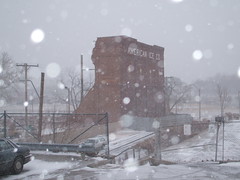
The ice house is melting.
Originally uploaded by maltoodle.
On my most recent trip back to Kansas City, I noticed that one of my favorite Kansas City landmarks is coming down. I forgot to pack the camera, but fortunately Maltoodle braved the snow recently to capture the dramatic image here.

The American Ice building hasn't held any actual ice for many years. Word has it barbecue baron Ollie Gates who owns the land has plans for commercial development in the area. And Bog knows that's much needed and long overdue in a part of town that has long been overlooked by developers. (Further scuttlebutt and some fine pictures here.)

All the same, I'm having trouble fending off nostalgia for the old brick pile. The American Ice building used to greet me every morning just after the 6:06 newscast when I'd step outside to grab the Kansas City Star from the loading dock. At least every other month I'd make a trip to the community recycling center that sat on the west side to drop off a load of gin bottles, egg cartons and cardboard boxes. A snap I took of it in '04 has also served as the wallpaper on every computer I've used over the last four years, a kind of anchor in the whirl of digital flotsam in which I seem all too often to abide.

The American Ice building was also reminder of the turn-of-the-20th, corrupt-expansive, meat-packing-City-Beautiful Kansas City that has been slowly crumbling away, as these things often do, especially in a city as demolition-happy as is the City of Fountains. It's probably a sign of my age but I realize that I've come to associate Kansas City with demolished architecture: the Mill Creek Viaduct, the Trolley Barn Neighborhood, Twin Oaks, the Mission Center Mall. If the paranoids are right, they may even aim the ball at Union Station some day.

There is a new crop of turn-of-the-21st, hocked-to-the-eyeballs, glass-euphoric new architecture sprouting in Kansas City (the Sprint Center, the Nelson's Bloch addition) but so far I'm having trouble warming to it the way I did to the old ice house.

Thursday, November 01, 2007

DT Archive: KC Street Names

By request, we return once again to the dusty, shallow confines of the Daytripper archives. The following column demonstrates that you can indeed spend four-plus hours poking around aimlessly in the library's local history collection and still have something to show for it. Photo at right: Petticoat Lane circa 1990 (by LI).

_____
It's all in a name (or was)
Kansas City View - November 1990

A breeze of controversy buffeted Kansas City in 1966 when the City Council announced its intention to officially rename the section of 11th Street between Main and Grand Petticoat Lane. All the change amounted to was making a customary title legal. Nevertheless, Hartzfeld's, a local clothier who operated on the street in question, objected. Hartzfeld's made a line of clothing called Petticoat Lane and claimed that its trademark rights would be diluted.

The name change went through, but as years passed and shoppers went elsewhere, the two blocks eventually went back to plain old 11th Street. These days, Petticoat lane, like Hartzfeld's, exists only in Kansas City's memory. Not a comforting thought since Kansas City has the collective memory of a flea.

Memory, though, is an odd thing. Take for example the 1988 controversy over naming a section of Maple Street in Independence Higashimurayama Avenue. Higashimurayama, a suburb of Tokyo, is Independence's sister city in Japan. The good folks of Higashimurayama had already renamed a major street in their town Truman Boulevard as part of the tenth anniversary of the sisterhood and the good folks in Independence were trying to do their part.

A group of about 50 veterans showed up at a council meeting to protest the change and, to read the Times account of it (May 3, 1988), the debate centered on whether Harry Truman was rolling over in his grave for or against the change.

"I believe Harry Truman would turn over in his grave if he knew something like this was going on behind his back," said former VFW Post 1000 Commander Buck Stodtman, mixing a sweet metaphor against the change.

The Times apparently couldn't reach the former president for comment. Suffice it to say, the forces of love and world harmony won out over xenophobia, and Higashimurayama is still in the family.

Most of the street name changes in Kansas City's history have been for the benefit of mail carriers and street car conductors. East-west streets were changed to numbers in 1869, which resulted in the loss of many feminine street names: Emily (6th street), Gertrude (17th), Catherine (18th), Amelia (l9th) and Adeline (20th), among others, were banished in one fell bureaucratic swoop, their long hair whipping in the wind.

In 1910, the Post Office, in a fit of excessive practicality, asked that all street names in Kansas City be changed to numbers. City Hall ignored the Post Office until the issue went away.

As the city continued to grow through annexation and other kinds of expansion, street names had to be changed. Many streets in town have had several names. 11th Street, for instance, was first called Chestnut east of Main. West of Main, it was Chouteau. Main Street used to be Eleanore. Grand used to be Market Street. Walnut Street, named for a walnut grove which stood at its north end, has always been Walnut.

A re-survey in 1931 eliminated many duplications in Street names, but was only a warm-up for the nomenclatural lalapolooza the city pulled of in 1947. As part of the Ten Year plan, 149 street names were changed overnight. City Hall explained that this was being done to avoid confusion.

Many streets which had names before became numbered terraces. Hence such names as Loma Linda Road, Bel Airy Place, Reservoir Place and Steptoe Street were gone, taking their music and rhythm with them.

The City Planning Department's escapades continued north of the river in the 1950s, but not without incident. The same system was adopted as south of the river: east-west streets numbered, with eight streets to a mile. A problem cropped up in 1951 when a two-block stretch of pavement was named Crane street because it fell between 45th Terrace and 46th Street. L.D. Klein, who lived at 608 Crane, took exception. The name didn't mean a thing to him. As it turns out, it didn't mean much to anyone else.

As an unnamed Kansas City Star reporter explained (Feb. 18, l95l): "Crane is a small town in Stone County down on the Arkansas line. The city employee that chose the name never lived there, has no friends or relatives there and no love for the place. It was just a short name so he put it on the city map."

So what's in a name? Plenty, if it's where you live.

___
Postscript: A companion to this column dealt with Petticoat Lane more extensively and elicited my only written response. I quoted from local history writer Mrs. Sam Ray, who wrote for the Star for many years, and a week or so later got a letter from some Poindexter there asking me not to quote from the late Mrs. Ray in the future, as her heirs found some of the advertising in the View unseemly. Massage parlor ads positively give some folks the vapors.

Concerted efforts on my part to find something else of Mrs. R's to incorporate ended in sad defeat.

Tuesday, August 28, 2007

Up for an eclipse?


eclipse
Originally uploaded by WoogglyBooggly.
For the last year, my job has involved getting up at an unspeakably early hour (OK, I'll type it: 3:30 AM). And today - finally! - it paid off.

I got up as bleary eyed as usual and began the daily routine. At some point, I noticed that C and the dogs were headed downstairs. Then I remembered: the eclipse. A ragged shadow was just creeping across the top of the visible moon when I made it downstairs. We took turns using the binoculars while the dogs hunted cicadas attracted to the yardlight.

There was just a sliver of reflected sunlight visible by the time I made it to work. I passed Terry from the cleaning crew on my way in and asked him if he'd seen the eclipse. Apparently he hadn't even heard about it. So we went back outside for a look at the ghostly rufous orb (sorry, English major).

A young guy was walking south on Troost, headed home I assume. He saw us gawking and swung his head that over that way, and did a full-body flinch at the sight of the huge red ball hanging over the Plaza. Can't say as I blame him. It was quite a sight.

-----
Thanks to Flickr user WoogglyBooggly in St. Louis for posting the beautiful image above. It's pretty much what I saw, give or take 250 miles.

Also: My co-way-too-early-in-the-morning-worker Michael and I also wandered out for a look. He has this take on his MySpace blog.

Friday, August 24, 2007

DT Archive: A Trolley Barn Requiem

Time for another trip to the Daytripper Archive. This time the sad tale of the Kansas City Trolley Barn neighborhood. Never heard of it? Read on...

----

A Trolley Barn Requiem
(originally published in the KC View January 11, 1991)

On the Saturday after Thanksgiving I was walking from the Plaza library to the View's offices at 48th and Troost. I passed the Theis Fountain, it's base dry and unseemly for the winter. My shoes picked up clods of mud from the field east of Theis Park, where UMKC students play flag football. After I crossed Rockhill Road and started down 48th Street, I began to stomp and stagger and drag my foot sideways through the grass to get the stuff off. There, it occurred to me that I had crossed over the western boundary of the Trolley Barn neighborhood. But boundaries are irrelevant in a neighborhood without houses.

In the distance, I saw a man weeping a metal detector over the torn up ground on the west side of Campbell Street, ground that used to be someone's front yard. I went over to talk with him.

He looked a little nervous as I approached. Nabokov wrote that "in an American suburban street a lone pedestrian is more conspicuous than a lone motorist." And in a vacant, decimated inner city neighborhood, you could probably add "threatening" to conspicuous.

I hailed him a half block off and smiled, thinking that might put him at ease.

"Finding anything?" I asked when I got close enough to be heard without shouting. .

"Nah," he said, taking off his earphones, "a couple pennies."

He glanced around, probably looking for something to hit me with if he needed to. Telling him I was a writer on my way to the office seemed to calm him a little but not much. I tried a little cajoling which I'm not very good at. He told me reluctantly that he was from Illinois that he was visiting relatives of his wife's whom he'd met while he was attending Central Technological Institute here in the early 1950s.

"I loved Kansas City then," he said after a pause. His sudden sad wistfulness surprised me. "I thought I was the greatest place. But it's not much of a city anymore.

I said that it certainly was a shame the city couldn't seem to maintain the neighborhoods in the older parts of town. Like the one we were standing in.

"I'm not racist or anything," he said, his voice dropping although we were the only two people in sight, "but the blacks have ruined that part of town. He gestured generally to the east. He told me about driving down the Paseo back then and how beautiful it was.

"The Paseo looks like the London Blitz now," he said.

When I suggested that there might be other culpable parties besides African-Americans, he said that he had to get back to his in-laws' place. He said he'd told them he'd be right back and that was an hour ago. I asked for his name as he headed for his car, in case I decided to write about the neighborhood, but he said he'd rather not give it. I wished him a good day and turned my face toward Troost.

It occurred a to me, facing that direction, that the African-American community is in no way responsible for the most prominent Blitz-esque remnant on the east side: Paseo High. And neither is it responsible for the wreck of the Trolley Barn neighborhood.

[Note: The original Missouri-limestone Paseo High School (picture right from paseo52.com)was torn down and replaced in the 1990s. At the time this piece was written, it was still a hollow shell awaiting the wrecking ball.]

The Trolley Barn neighborhood got its name from the Kansas City streetcar barn (formerly at 48th and Harrison) where the trolley cars were parked at night. Many streetcar employees had homes in the neighborhood, which remained placidly upper-middle class until the streetcars stopped running in 1957.

This wasn't a fatal blow to the neighborhood. Some residents moved out but some remained to mix with the new, younger neighbors who moved in. University employees moved there throughout the 1960s, as did artists and writers. Two literary magazines -- The Harrison Street Review and Chouteau Review began publishing in the neighborhood in the 70s.

The fatal blow came with the Brush Creek flood of September 12, 1977. Many homes were damaged and while private homeowners began to make repairs, houses owned by the University of Kansas City Trustees fell into disrepair less than a month after the flood, tenants of the trustees were given eviction notices and told vacate by the end of the year.

Protests were made, suits were filed and a few houses were spared but the battle was lost. The Trustees wanted the land. In 1978, the Trolley Barn, a red brick building built in 1910, came under the wrecking ball before it could be declared a historic site. There is a large parking lot in its place now. As surrounding houses in the neighborhood were bulldozed, what do you suppose happened to property values?

Watching this neighborhood die for several years was like watching an elderly neighbor on the decline. The neighborhood was already wizened when I first encountered it, but there still seemed to be signs of normal life in its buildings, businesses and people. There was Joe's Fantasy Island Barber Shop, the fabled Kaye's Rockhill Bar, and even a masque for Islamic students at UMKC. The bulldozers blade has removed them all.

The long awaited, much touted, highly contested University Park research development is on its way. Whether we'll be all that thrilled when it arrives is a story for another day. To borrow the terminology of the Star's real estate writer, the first building should be "coming out of the ground" this year.

For now, the neighborhood is a grid of empty streets and sidewalks, sparsely populated by trees, which actually do come out of the ground. On their own, the trees would stay, putting out leaves every spring, dropping them in the fall, all the while changing carbon dioxide into oxygen. But the bulldozers will find them, and then the neighborhood will really be dead.

Postscript - 2007
Looking back, things haven't turned out so badly for the Trolley Barn Neighborhood. Yes, the houses are all gone and so are the bars. But the area now houses the headquarters of the Kauffman Foundation and the Anita B. Gorman Conservation Discovery Center, an urban conservation campus run by the Missouri Department of Conservation and the Missouri Department of Natural Resources. And a fair chunk of it is still a large open field, frequented by geese, which some people detest. I pass it everyday going back and forth to work.

The aforementioned University Park died a sputtering death overseen by keen lawyers about nine months after I wrote this column. More on that next time.

Wednesday, August 01, 2007

DT Archive: Bridge to Nowhere

Without emaw, would I blog at all? A fair question. When I finally met the guy a last week at the KC blogger meet up, I discovered that he is one of three living humans in North America (RIP Hiebsch) to have actually read the Daytripper archive pages I lovingly coded a few years back.

Background: For eight months in 1990-91, I wrote a column called Daytripper for the The KC View (RIP KC View). I was supposed to be about local travel, but I ended up obsessing over the Kansas City I saw disappearing around me. One consistent theme was the city's vanished streetcar system.

And now that the city's transit system is once again something to obsess over, it seems like as good a time as any to unearth my youthful experiments in journalism. Enjoy (RIP Enjoyment).


Bridge to Nowhere
[Original pretentious title: “Where my hair grows, there grow I”]
K.C. View December 28, 1991

“…making yourselves sick, that you may lay up something against a sick day.”
-Thoreau

When I was a college student in Liberty and wanted to drive down to the Plaza, I knew I had two exits to choose from when it came time to leave I-35 South: either Broadway or Southwest Trafficway. I took the Broadway exit whenever I could, because Broadway seemed like a much happier street. Southwest Trafficway was quicker, but the way it deposited me on the Plaza left me feeling like a cheeseburger at the end of a stainless steel chute.

Since moving into Kansas City and, indeed, onto Broadway, it seems strange that I once thought the street or the area happy. It’s my neighborhood now; where I work, where I buy groceries, where my hair grows. It has lost the aura of novelty it once held for that kid from South Dakota.

There were two good things about driving down Broadway, before I knew Broadway. First, there was the jog it takes after 40th Street. This bend in the road brings you to Westport, with its warm brick buildings, its lights and activity. These things struck me, flying by at 35 miles an hour, as profoundly happy. Later I would work in Westport and come to view the place differently.

The other thing I enjoyed about Broadway was the bridge that cuts across it diagonally at 43rd. I could never discern any purpose to it, since nothing ever seemed to cross over it, but something about it was, and still is profoundly pleasing, if not happy. It was an easy landmark, something to help me get my bearings in a city at that time seemed so big. After I moved into the neighborhood, the bridge became like another piece of furniture to me. For years I was among the many who drove under it day in and day out without knowing what it was.

The bridge is a remnant of the Country Club Line, a part of the old streetcar system that ran from Westport through the Plaza, Brookside and Waldo and then on south to 85th Street. In its prime, the Kansas City streetcar system, one of the most extensive in the U.S., carried 300,000 passengers a day. The Country Club Line--specifically who owns it--has been a legal issue almost since the day the street-cars stopped running in the late 1950s.

And it remains a legal issue. The Kansas City Area Transportation Authority (ATA) paid $1 million to buy the line in 1981 with the intention of building a new light-rail system along it and has so far paid $675,000 in legal fees to prove their ownership. ATA officials have set no ceiling on future legal costs and can’t estimate with any certainty when the new line will he built. All the same, they blithely claim that the cost of a new rail line south of the Plaza will be around $50 million. So if all goes well we may soon--sometime in the next century anyway--have a fast, efficient rail system linking downtown to Waldo and points south.

About two years ago, I walked across the bridge on my way to work. There were broken bottles, graffitti, and weeds sprouting from the dirt that had collected around the rails. A few weeks ago, I took another look and found chain link fences at both ends.

I asked Ron Guglielmino, rail manager for the ATA about it. He, too, recalled walking over the bridge a few years ago, but didn’t realize that it had since been fenced off. Ron didn’t know about the fences, he said, because he deals with long-term aspects of the rail line. Another ATA employee deals with short-term things like putting up fences. Ron gave me that employee’s phone number.

Then Ron dropped the bomb: someday the bridge will be torn down. It doesn’t figure into the new rail plan and the city would like to clear it out for better traffic access. Undoubtedly the bridge gives beer truck drivers trouble getting to and from the Levee, a nightspot around the corner. No date has been set for the bridge's demolition. It could be in ten years or fifty, nobody knows. But it will go; the powers that be have so decreed.

I know the bridge serves no real purpose. It so longer does what a bridge is supposed to do. It connects nothing but two grassy hills and two stretches of abandoned rails. But I will mourn its loss, and with good reason. When the bridge goes a part of my life will go with it.

The bridge is a ruin and performs the function of a ruin ably. It grounds our sense of place. It used to tell me where I was, back before I knew my way around. And it continues to be a marker for me, telling me both where I've been and reminds me of both failures and triumphs past and keeps me, in the best sense of the word, humble.

It serves the city as a marker, too, reminding us that we will spend hundreds of millions of dollars over the next half a century to replace what we already had a little over 30 years ago.

---

Postscript: The Mill Creek Viaduct was designed in 1928 by Edward Buehler Delk, who also designed much of the Country Club Plaza for J.C. Nichols. The bridge outlasted both the creek (which was diverted below ground) and the streetcars (which stopped running in 1959). It stood as a beautiful urban ruin until was finally demolished in 1996.

More information on The Mill Creek Viaduct and Edward Buelher Delk is at the Historic Kansas City Foundation website.

Wednesday, April 25, 2007

Cedar Waxwings


Cedar Waxwing
Originally uploaded by camden hackworth.
One of the highlights of this spring was the visit we received from a flock of cedar waxwings. The showed up one day looking like masked bandits and parked themselves in the bare limbs of our neighbor's Little Leaf Linden tree. A couple times a day they swept in to devour the barries on and under our holly tree. Within a week, most of the berries were off the ground. Gorged on sugar, the flocked moved on.

(Our camera died so I'm borrowing this image from a fine Flickr fan.)

Before this visit, my only association with waxwings was from the opening lines of the epic poem in Vladimir Nabokov's meta novel Pale Fire. I went around repeating it for weeks:

I am the shadow of the waxwing, slain
By the false azure of the window pane.


Nobody got fooled by our windows. I'm looking forward to next year's visit.

Wednesday, January 10, 2007

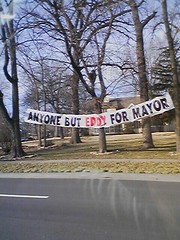
Someone is unhappy with Dr. Chuck

This banner has been up for a couple of weeks but I just got around to snapping a shot with my wizbang new camera phone. (Hence the quality.)

Curiously, the sign is on fancy Ward Parkway, not in Redbridge, where Councilman Eddy has made so many friends with his plan to widen Redbridge Road.

I wonder whether the KC sign police are considering action. Is it a yard sign if it's hanging from the trees?

---

My feature on Kansas City jazz musician Russ Long's last recording project ran this morning. More info and links coming to The New Low Down soon.

Friday, January 05, 2007

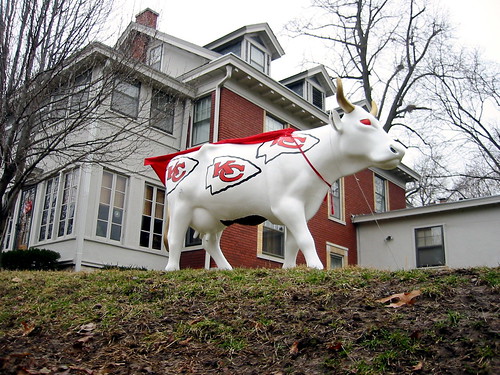
Hopeful Sportcow

One day before the NFL playoffs begin and the KC Sportcow near 53rd & Main appears hopeful for a Chiefs victory. In case you can't tell, there are wires holding that red cape aloft. On a windy day it's pretty spectacular (-ish).

Recent Sportcow photo ops missed:
  • Festive Sportcow pulling a tiny sleigh with Christmas lights.
  • Sad Sportcow with a "Thank You Mr. Hunt" sign
You may remember the vaguely Abu Ghraib-ish Sportcow from baseball season.

Friday, November 24, 2006

Ida McBeth

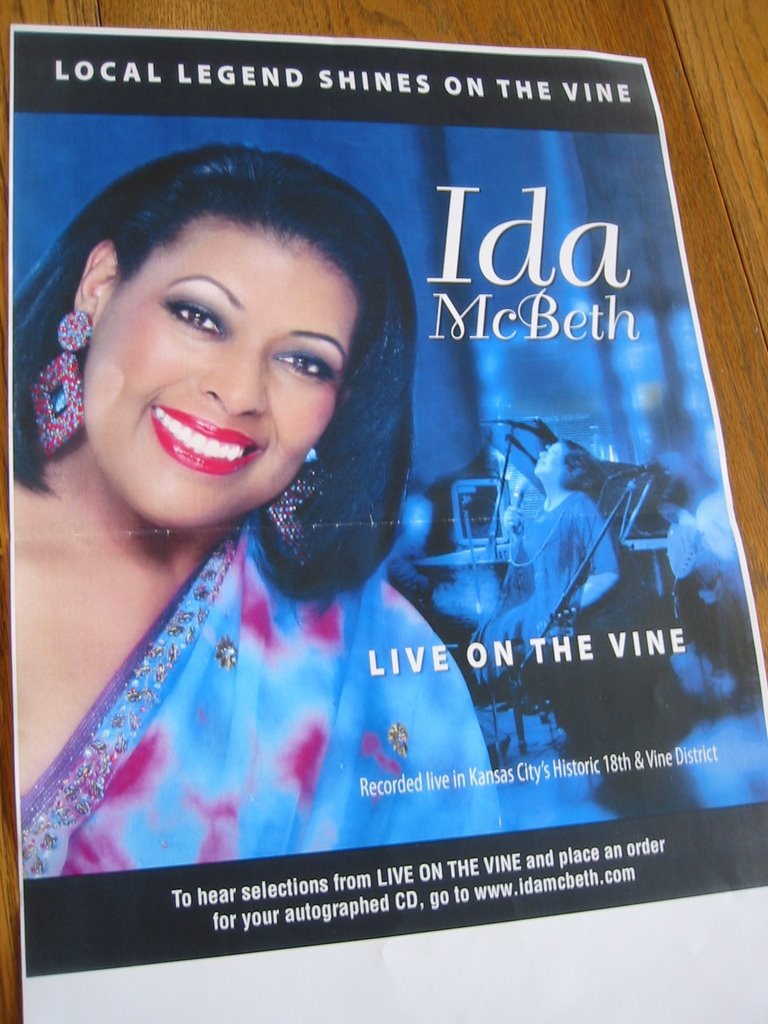
I had the pleasure of interviewing a great Kansas City singer this week. Ida McBeth has been laying down solid blues, jazz, soul and funk in KC since the late 60s. While she's not well known outside Kansas City, audiences here continue to gather for her regular gigs at Jardine's and the Blue Room.

Here's the feature I put together from our half hour of chat.


She releases her fourth album today. "Live on the Vine" was recorded at the Blue Room at 18th and Vine. While it suffers from the Blue Room's so-often-poorly-tweaked sound system and a few weak song choices, Ida's voice still shines through as the wonderful thing it is.

Personal note: I first caught Ida's act in the late 80s at The Point, a kind of neighborhood joint that has gone they way of the rotary dial phone. The show was always amazing, particularly to a kid who had just drifted out of South Dakota. Between sets, Ida would make a beeline for a stool at the far end of the bar, where she'd wait with her head down until it was time to go back on stage. Turns out that around that time, not only was Ida's mother dying of kidney disease, but Ida and her husband Roy Searcy were going through a divorce. Talk about living the blues.

» To find out more about Ida than I could fit in 5 minutes and 20 seconds (not counting music) check out Tim Finn's profile of Ida from Monday's KC Star.

» And here's a "bootleg" video of Ida and her band at the Corporate Woods Jazz Fesitval doing Willie Dixon's "Wang Dang Doodle."